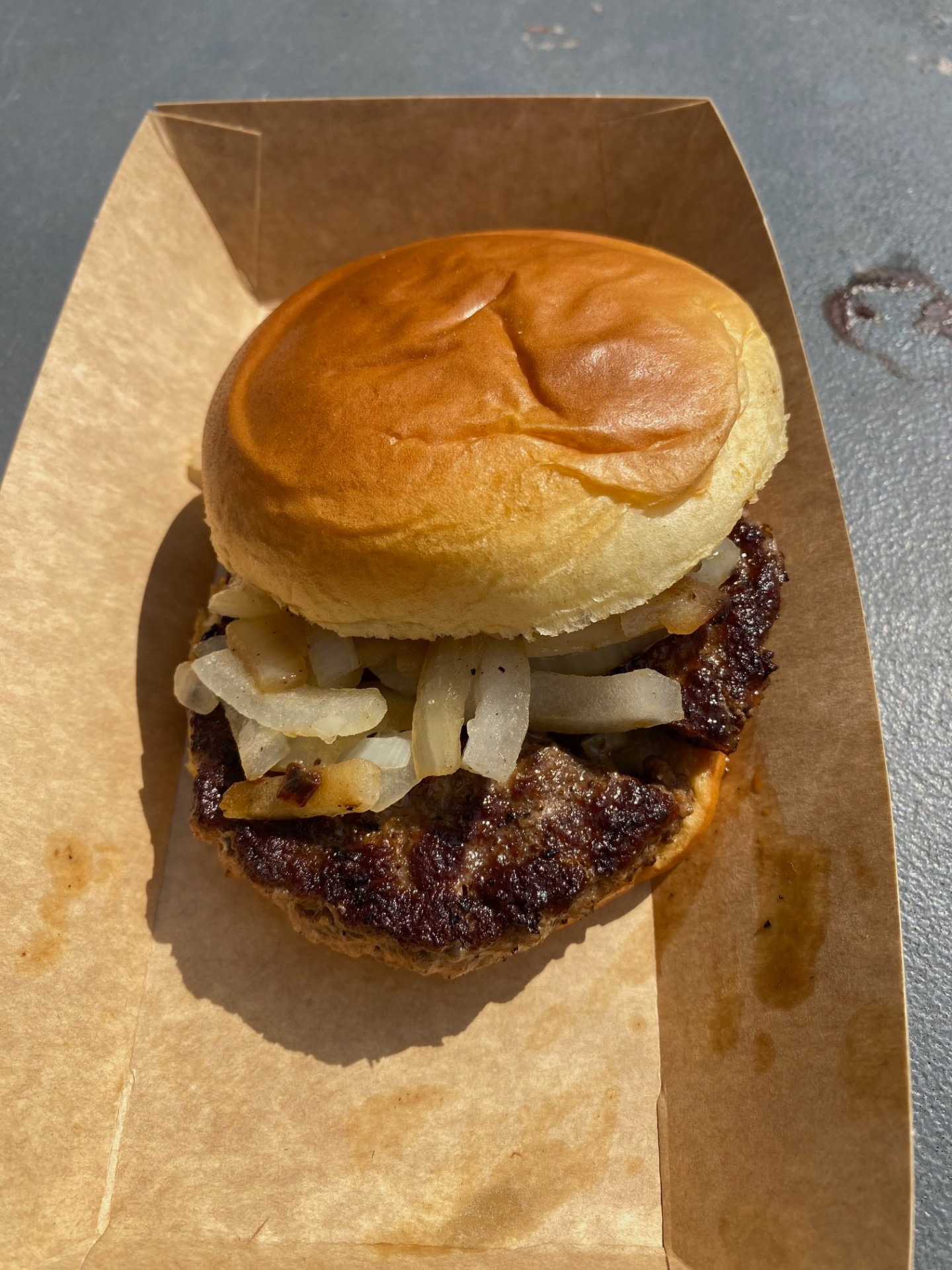
Burger Index: Raynes Park Vale
A £6 burger with 50p extra for onions, £10 admission and a £6 pint of Birra Moretti at a tier-eight club that has just reported a balance-sheet swing of more than £1m, seen Kingstonian depart as a groundshare tenant and changed controlling shareholder inside twelve months.
- Raynes Park Vale's plain beef burger costs £6, with fried onions another 50p. It scored 7.6/10.
- Adult admission at Grand Drive is £10, with concessions at £6 and 14–20-year-olds paying £3.
- Birra Moretti is £6 a pint, making the standard Burger Index afternoon £22.
- Raynes Park Vale lost 3–2 to AFC Stoneham on Saturday 10 October 2026, watched by 257 spectators.
- Accounts to 31 August 2026, approved three days after this fixture, show net assets of £131,369 against a £901,348 deficit the previous year — a swing of £1,032,717, with creditors due after more than one year down £917,468.
- Companies House records a share allotment and a change of controlling shareholder to Rohini Finch, both dated 15 December 2025.
- Kingstonian ended their groundshare at Grand Drive in April after the club sought a higher rent and a contribution to pitch maintenance.
The index entry
| Ground | Prince George's Playing Fields, Grand Drive, Raynes Park |
| Fixture | Raynes Park Vale 2–3 AFC Stoneham, 10 October 2026 |
| Competition | Isthmian League South Central Division, tier eight |
| Item | Plain beef burger |
| Price | £6.00, plus 50p for fried onions |
| Admission | £10 adult |
| Pint | Birra Moretti — £6.00 |
| Rating | 7.6/10 |
The burger
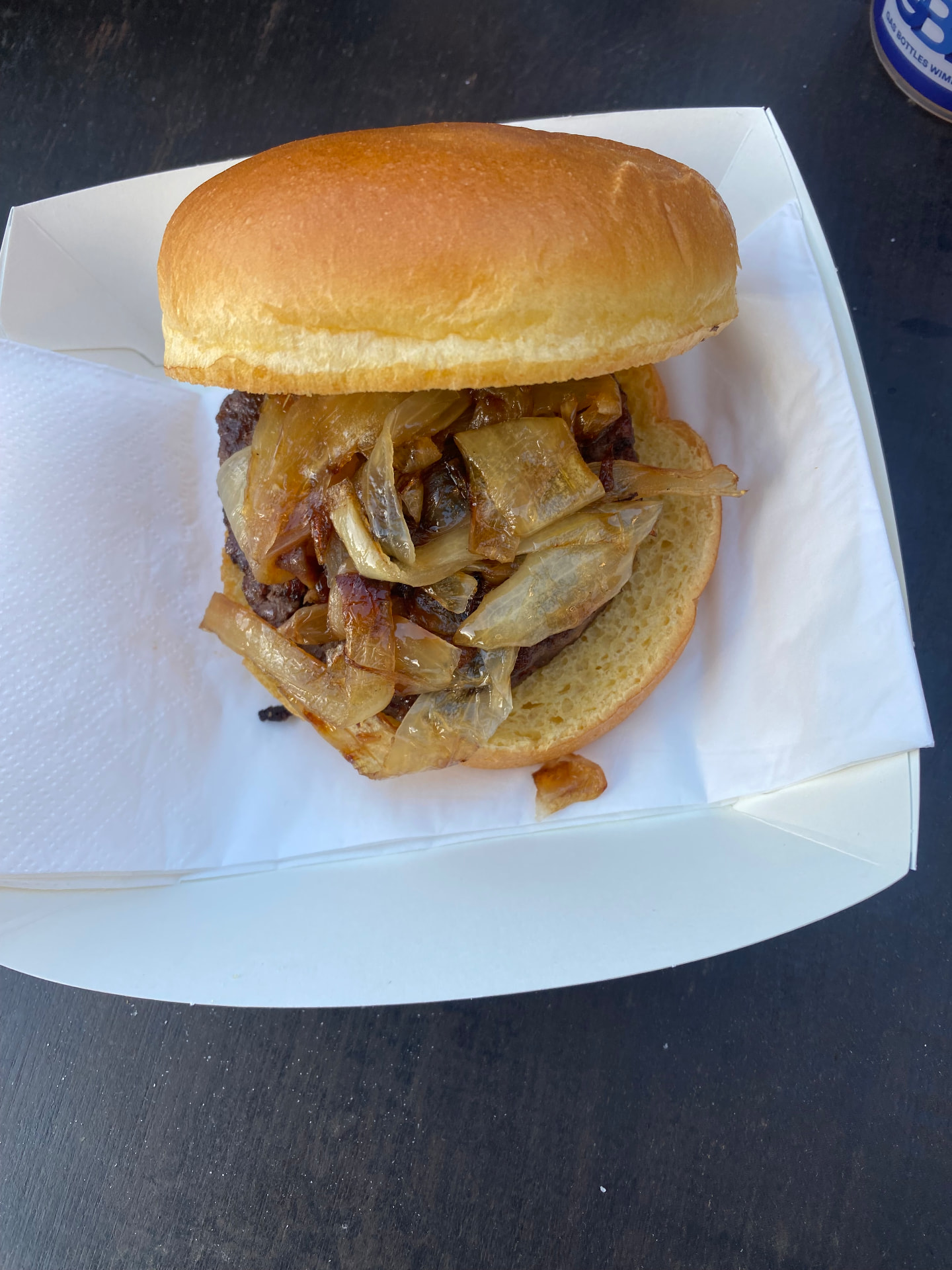
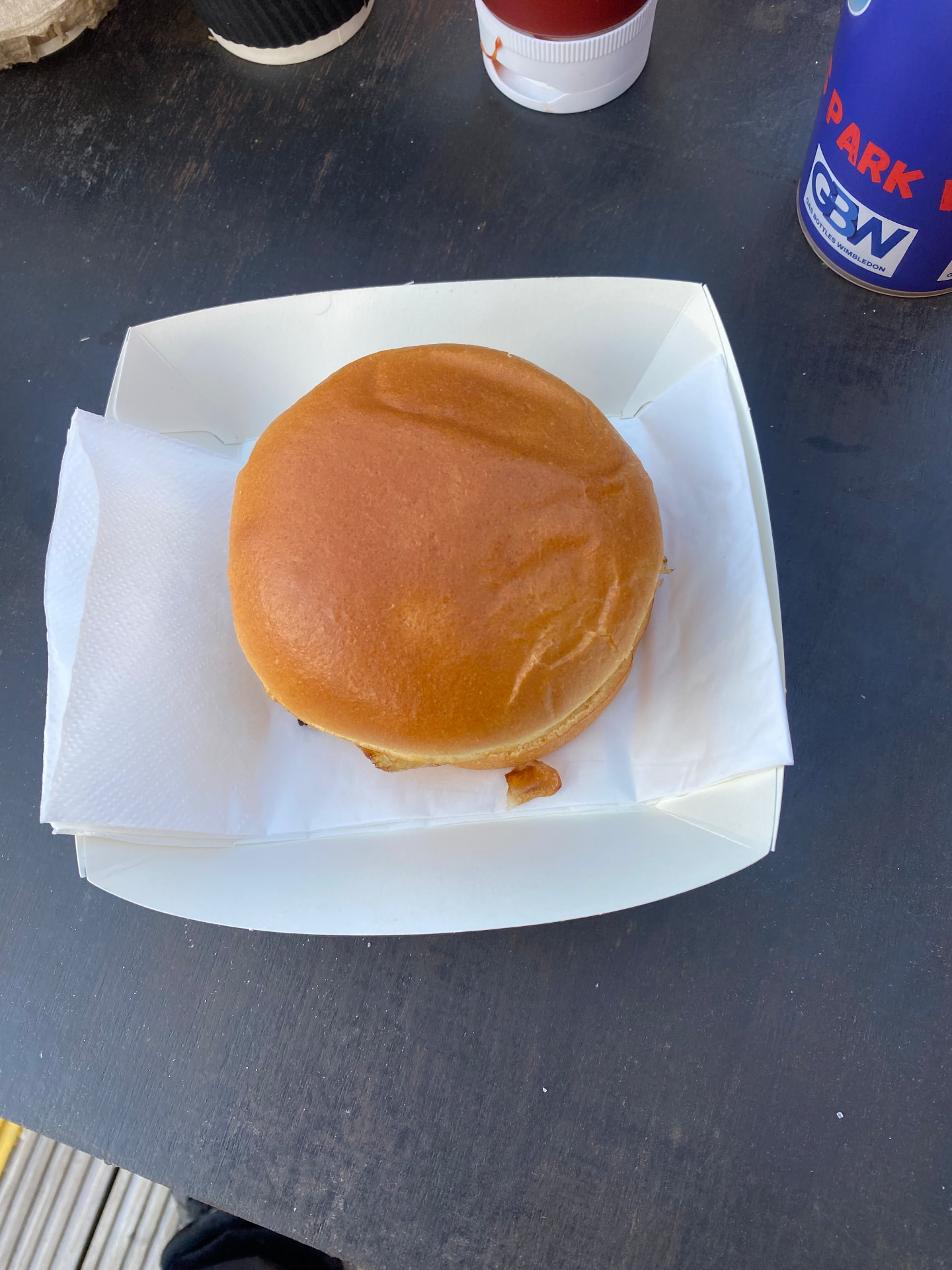
Raynes Park Vale's burger is a familiar non-league offering: a beef patty, a soft white bun and a generous portion of fried onions, arriving in a cardboard tray without much in the way of presentation or anything pretending to be restaurant food. At a football ground, that is not necessarily a criticism. The patty had some browning, the bun was soft and the onions were plentiful. There was nothing particularly distinctive about it and equally nothing seriously wrong — a decent, straightforward football burger of the sort that satisfies without leaving much of an impression afterwards.
The problem is the price structure. The menu advertises a plain burger at £6, already a fairly substantial amount for a basic offering at tier eight, and fried onions cost another 50p. They are such a routine part of the traditional football-ground burger that charging separately for them feels unnecessarily precise. The £6.50 we actually paid is not unreasonable in absolute terms, but it is difficult to argue that the extra 50p materially improves the club's catering proposition. The onions were generous; they just ought to have been included.
7.6/10. That puts Raynes Park Vale level with Carshalton Athletic and above Racing Club Warwick on 7.3, Hampton & Richmond on 7.2 and Sutton United on 6.1. It remains well short of Kingstonian and their 9.2. A slightly better-than-average burger, priced a little more ambitiously than its quality warrants.
The price list, read as a financial document
The first encouraging figure at Grand Drive is the £10 admission charge, and the structure beneath it is genuinely accessible: concessions pay £6, supporters aged 14 to 20 pay £3, and under-14s are admitted free when accompanied by a paying adult. For a club at the eighth tier, that is a deliberate attempt to keep the gate open to people who might otherwise not come.
The food board is less generous. A plain burger costs £6, a cheeseburger £6.50 and a fully loaded burger £8.50. A hot dog is £3.50, a sausage roll £3 and chips £3.50, with smaller items including crisps at £1.20 and cookies at £1.75. The onions are a curious detail: the hot dog board lists additional onions and cheese at 50p each, while the burger prices leave onions outside the basic offering altogether. For the Burger Index, which compares plain burgers rather than upgraded versions, the £6 base price is the one that counts.
Then there is the beer. The draught selection includes Birra Moretti at £6 a pint, Spitfire at £5 and First Drop IPA at £6, with bottled Peroni and Corona at £3.50 and Guinness listed at £4. A £6 pint of Moretti is not exceptional by London standards, but it is expensive in the context of the lower non-league pyramid. At Racing Club Warwick, Church Farm Pilsner was £2.50. Sutton United, four divisions higher, charged £5.90 for Signal Lager. The comparison is not exact — different breweries, supply contracts, serving arrangements and commercial terms all matter — but the price to the supporter is clear enough.
Our standard Raynes Park Vale afternoon comes to £22: £10 admission, £6 for the plain burger and £6 for the pint. That is £5.50 more than Racing Club Warwick's £16.50 afternoon despite Raynes Park Vale playing one tier lower, and considerably less than Sutton United's £38.40 evening in the National League. The admission price does most of the work in keeping the visit affordable. The food and drink are closer to what you would expect at a substantially larger club.
The club that left
Until this spring, Grand Drive had two resident clubs. Kingstonian had been groundsharing there, and in April their chairman George Vasilaras set out publicly why they would not be staying. According to Vasilaras, Raynes Park Vale had offered an extension, but on terms that involved a substantially higher rent and an additional contribution towards pitch maintenance. Kingstonian declined, he said, because of both the increased financial burden and the risk of further postponements caused by drainage problems at the ground. They moved their groundshare to Ashford Town (Middlesex) instead.
Neither the former rent nor the income forgone has been disclosed, so the size of the hole is not establishable from the outside. But the direction is clear enough: a club at the eighth tier, with a few hundred paying through the gate on a Saturday, no longer has a rental income stream that did not depend on its own attendances at all. Groundsharing income is one of the few revenue lines available to clubs at this level that is genuinely independent of results, weather and the size of the home support, which is precisely what makes it valuable.
There is a neat symmetry in where Kingstonian went. Ashford Town is where this Index started, and the Kingstonian burger recorded there remains the highest-scoring entry we have made.
A change on the share register
Raynes Park Vale FC Limited, company number 13560754, was incorporated in August 2021. Unlike the unincorporated members' clubs found elsewhere in non-league football, it has a formal corporate structure, directors, shareholders and annual Companies House filing obligations — which means there is something to read.
The company was formed at a point when the club's future was uncertain. Contemporary reporting described Raynes Park Vale as having come close to folding after the pandemic removed both fixtures and bar income, with the club secretary saying preparations for closure were already under way before new financial backing arrived. Bob Finch, who established the limited company, has been identified publicly as chairman since. He is a co-founder of the venture capital firm Talis Capital and was previously a senior figure at the commodities trader Vitol, and in March 2022 he was named as part of the Centricus-led consortium that bid for Chelsea, alongside Jonathan Lourie of Cheyne Capital, under Centricus chief executive Garth Ritchie and co-founder Nizar Al-Bassam. That is an unusual financial background for a club at this level, and it matters mainly because it explains how a tier-eight operation came to be structured and funded the way it is.
The register has since changed. Robert Paul Finch's status as a person with significant control, held through at least 75% of the company's shares and voting rights together with the right to appoint or remove directors, ended on 15 December 2025. On the same date Rohini Finch was recorded as holding at least 75% of the shares. The club's own matchday programme identified Rohini Finch as its significant shareholder in September 2026, so the change is reflected in the club's public disclosures as well as the register. Bob Finch remains a director, alongside David Harry Finch and William Michael Pollard, and continues to be named as chairman, with the former England international John Scales as chief executive.
The filings establish a change in registered ownership but not its commercial terms, and no purchase price is disclosed. Nor does a change in significant control necessarily mean a change in the people running the club — the directorships and the publicly named officers are substantially unchanged. That distinction between ownership and operation matters at this level, where an individual shareholder can be central to a club's financial survival without being the person handling its day-to-day football decisions.
A million pounds off the balance sheet
The accounts to 31 August 2026, approved by the board on 13 October, three days after this fixture, are where the year becomes genuinely interesting.
The company reported net assets of £131,369, against net liabilities of approximately £901,348 a year earlier. That is a swing of £1,032,717 in a single financial year at a club whose home attendances run to a few hundred. The largest movement was a £917,468 reduction in creditors due after more than one year. Short-term creditors fell by another £89,063, while current assets rose £53,027 and fixed assets declined £26,841. Together, those movements account for the full £1,032,717 improvement. What the accounts do not explain is how the liabilities were discharged.
The company files under the micro-entity regime, which means turnover, wages, gate receipts, sponsorship income and operating profit are not separately disclosed, and there are no notes setting out the terms of the creditor balances or the circumstances in which they were reduced. A movement of that size could reflect repayment, a waiver, or some other arrangement, and those have very different implications. Repayment requires cash to have come from somewhere. A waiver removes an obligation without a corresponding payment. Neither can be established from a micro-entity balance sheet, which reports total capital and reserves without a statement of changes in equity or any account of the transactions behind the figure.
There is a separate filing from the same period. On 15 December 2025, the day Rohini Finch became the controlling shareholder, the company allotted new shares, with an SH01 return filed on 5 January 2026 recording total nominal share capital of £51 following the allotment. An allotment creates new shares rather than transferring existing ones, which is a different transaction from a simple change of owner. But £51 is nominal capital, not money invested: shares can be issued at a premium, and the return itself would be needed to establish the number, class and consideration involved. The allotment is a lead worth following. It does not, on what has been published, explain the balance-sheet movement.
One source of external capital is independently identifiable. In December 2024 the Premier League reported that £155,000 from its Stadium Fund had supported improvements at Grand Drive, covering turnstiles, perimeter fencing, officials' changing facilities and dressing-room extensions. That is real money from outside the club, but it is infrastructure grant funding from two financial years ago and should not be read as explaining the 2025/26 creditor movement.
The commercial model beyond the turnstiles
The club's public commercial offering provides another window into how it seeks to finance itself. Raynes Park Vale advertises a local-business network membership at £195 plus VAT, community partnerships at £395 plus VAT and official club partnerships starting at £1,000 plus VAT, with larger principal partnerships negotiated individually. It also promotes an annual membership scheme at £15, with a digital membership card, free digital matchday programme and merchandise discounts — another attempt to convert occasional attendance into a more consistent relationship.
These are advertised rates, not disclosed receipts. There is no public breakdown showing how many businesses subscribe to each tier or what the club receives from its principal sponsors. Nevertheless the structure is revealing. At a ground attracting a few hundred spectators, even small commercial agreements can make a meaningful contribution: a £1,000 partnership is equivalent to 100 full-price adult admissions before considering VAT treatment, operating costs or concessions. That does not mean the club receives £1,000 of profit, but it demonstrates why small-business relationships matter more here than higher up the pyramid — and why a groundshare arrangement is worth more than its headline rent.
The match
AFC Stoneham led early, Raynes Park Vale equalised before half-time and the visitors eventually took the points 3–2 despite a late home goal. The official attendance was 257, a reasonable Saturday audience at tier eight.
At the published adult price of £10, 257 full-price adult admissions would produce £2,570 — but that is not a gate-receipts figure. Some spectators will have paid concessionary prices, some may have entered through season tickets or membership arrangements, and others were admitted free. The club's actual cash receipts from the fixture have not been disclosed. The catering position is even less transparent: the prices are on the board, but not how many burgers or pints were sold, whether catering is operated directly or through a concession, or how revenue is shared. A £6.50 burger cannot be translated into a reliable estimate of club profit once food cost, labour, equipment, utilities, waste and any catering commission are taken into account.
Why it matters
Raynes Park Vale illustrates a familiar tension in lower-league football. Keeping admission affordable helps attract supporters, particularly younger spectators and families, and the £3 price for 14–20-year-olds and free admission for accompanied under-14s are meaningful commitments at a level where attendance is central to the matchday experience. But lower admission prices also limit what a club can take from each paying spectator, which makes catering, sponsorship, groundsharing and membership correspondingly more important.
The £6 pint and the extra 50p for onions are small details individually, yet they sit within that wider picture. Supporters are offered a reasonably priced ticket and then asked to spend more once inside — and the club asking its groundshare partner for more, and losing the arrangement, belongs in the same column of the ledger.
What makes this entry unusual is the scale of what sits behind the price list. Most clubs at the eighth tier have balance sheets that move by tens of thousands. This one moved by more than a million pounds in a year, with no public explanation of how, while changing controlling shareholder and allotting new shares in the same twelve months. The burger tells you what an afternoon costs. It does not tell you who is paying for the rest of it.
Frequently asked
How much is a burger at Raynes Park Vale?
A plain beef burger costs £6. Fried onions are an additional 50p. We rated it 7.6/10.
How much does it cost to watch Raynes Park Vale?
Adult admission is £10. Concessions pay £6, supporters aged 14–20 pay £3 and accompanied under-14s enter free.
How much is a pint at Raynes Park Vale?
Birra Moretti is £6 a pint. Spitfire is £5 and First Drop IPA £6, according to the drinks board at the ground in October 2026.
What is the total Burger Index cost at Raynes Park Vale?
£22 for adult admission, a plain burger and a pint of Birra Moretti.
What was the result against AFC Stoneham?
Raynes Park Vale lost 3–2 at home on Saturday 10 October 2026, with an official attendance of 257.
What tier are Raynes Park Vale?
Tier eight, competing in the Isthmian League South Central Division in 2026/27.
Who owns Raynes Park Vale?
Raynes Park Vale FC Limited is privately controlled. Companies House records Rohini Finch as holding at least 75% of the shares from 15 December 2025, following the cessation of Robert Paul Finch's significant-control status. Bob Finch remains a director and is named as chairman.
Are Raynes Park Vale profitable?
The micro-entity accounts do not disclose turnover or operating profit, so annual trading profitability cannot be established from them. The accounts to 31 August 2026 do show net assets of £131,369, reversing a £901,348 deficit, with creditors due after more than one year down £917,468.
Why did Kingstonian leave Grand Drive?
Kingstonian's chairman said in April 2026 that Raynes Park Vale had sought a substantially higher rent and a contribution towards pitch maintenance, and that the club declined because of the cost and the risk of postponements from drainage problems. Kingstonian moved to Ashford Town (Middlesex).
What is the Burger Index?
A regular feature at The Pyramid. We buy a plain burger at football grounds, rate it out of ten and examine what the food, beer and admission prices reveal about the finances of clubs throughout the English football pyramid.
Sources
- accessed 19 Oct 2026
- Companies House — Raynes Park Vale FC Limited (13560754): filing history, including micro-company accounts and SH01 return of allotmentaccessed 19 Oct 2026
- accessed 19 Oct 2026
- accessed 19 Oct 2026
- accessed 19 Oct 2026
- accessed 19 Oct 2026
- accessed 19 Oct 2026
- BBC Sport — Chelsea: Centricus bid to buy club intends to 'maintain existing management' (21 Mar 2022)accessed 19 Oct 2026
Football’s money, all the way down — every week, free.
Ownership, accounts and the real cost of a matchday, from the Premier League to tier ten. No spam, unsubscribe any time.
Subscribers can also enter The Pyramid 1st Season Giveaway.