Burger Index: Leyton Orient
A £6.95 burger at Brisbane Road, and the £4.6m loss sitting behind Leyton Orient's record revenue and new ownership.
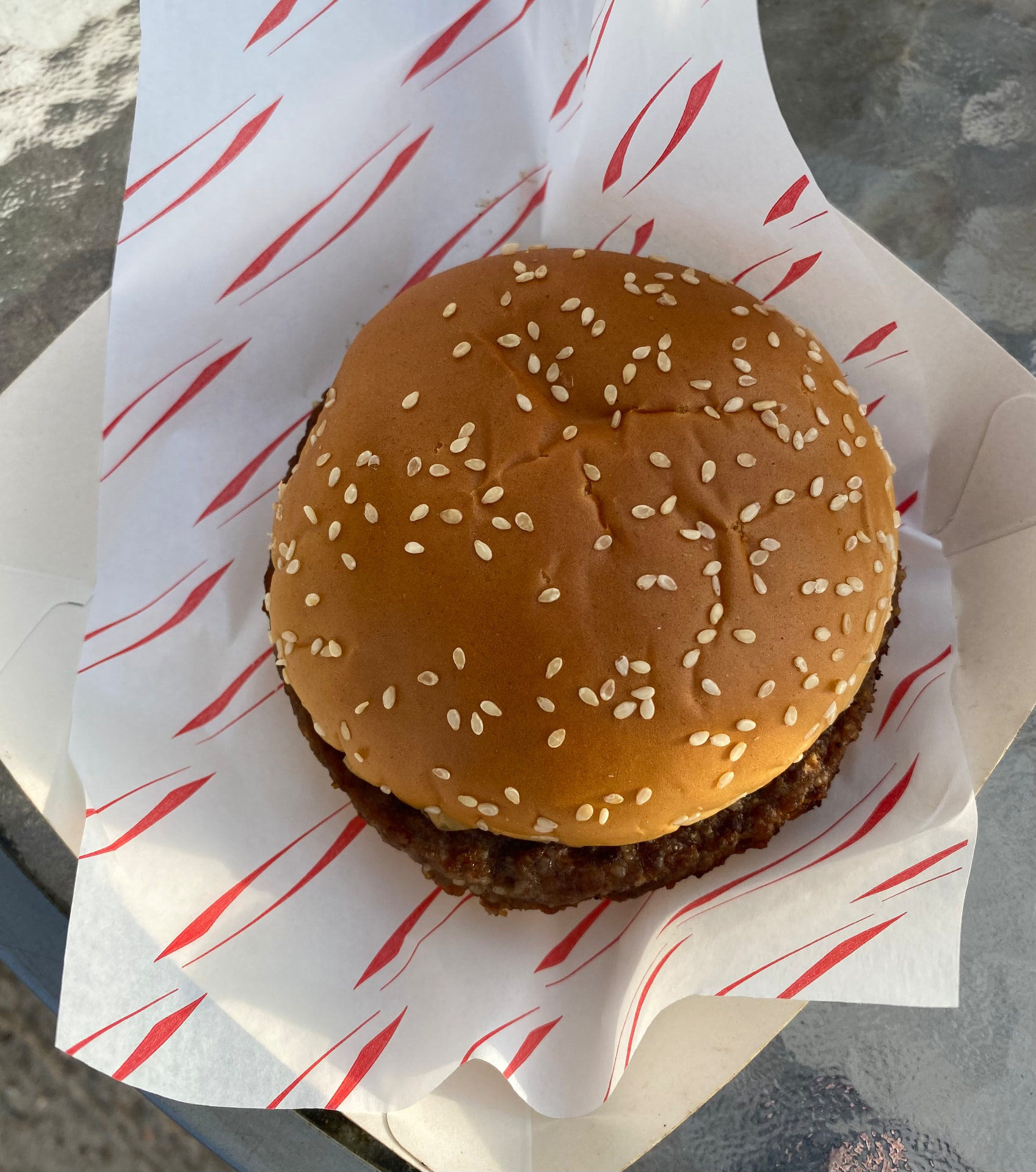
- £6.95 for the 6oz Beef Burger at Brisbane Road — 7.2/10, and the most expensive item the index has recorded.
- Admission was £15.00, booked in advance, for a Carabao Cup first-round tie against Oxford United.
- Hurlimann was £6.20 on the concourse — the same beer cost £7.20 at Millwall.
- Leyton Orient generated a club-record £9.4m of income in 2024/25 and still lost £4.6m.
- David Gandler's consortium took control in April 2025, holding 78.55% of the new ownership vehicle.
Same rules as always: one item, no additions, price list read as a financial document. This one comes from Brisbane Road and a Carabao Cup first-round tie between Leyton Orient and Oxford United.
The index entry
| Ground | Brisbane Road, Leyton |
| Fixture | Leyton Orient (H) v Oxford United, Carabao Cup 1st Round |
| Item | 6oz Beef Burger |
| Price | £6.95 |
| Admission | £15.00 (booked in advance) |
| Premium lager | Hurlimann — £6.20 |
| Rating | 7.2/10 |
The burger


It looked better than most football burgers do. A proper 6oz patty, visible char, substantial bun and enough about it visually to suggest the £6.95 price might be justified. It ultimately didn''t get finished, which is worth recording rather than pretending otherwise. A 7.2 on an unfinished burger is a different verdict from 7.2 on something demolished before half-time.
The price is more interesting when put beside what we''ve already found elsewhere. QPR charged £5.60 for a considerably poorer factory-produced burger. Carshalton Athletic''s was £5.00. Kingstonian''s benchmark 9.2 came in at £4.50. So Leyton Orient is currently the most expensive burger in the Index, but not remotely the worst value.

The lager gives us another useful comparison. Hurlimann costs £6.20 at Brisbane Road. The same beer was £7.20 when we encountered it at Millwall. Identical product, two London football grounds, £1 difference. That''s exactly why we record these things.
Orient''s finances
The more interesting numbers at Brisbane Road are not on the concourse.
Leyton Orient generated a club-record £9.4 million of income in 2024/25, up from £7.7 million a year earlier. Retail revenue alone reached roughly £600,000. And they still lost £4.6 million.
That is the contradiction at the centre of modern League One football. Orient are not a failing commercial operation. Revenue is growing. Crowds have strengthened, sponsorship has developed, and the club reached the League One play-off final during the period covered by the accounts. The problem is that the cost of attempting to move upwards is growing even faster.
A crude comparison illustrates the scale. A £4.6m annual loss against £9.4m of income means the deficit was equivalent to almost half the revenue the club generated during the year. A few thousand extra burgers do not solve that.
Orient''s previous ownership understood the problem. Nigel Travis had already argued publicly that losses across League One were unsustainable, and that additional investment would be required if the club wanted eventually to establish itself in the Championship.
In April 2025, that investment arrived. A consortium led by Fubo founder David Gandler took control of Leyton Orient, with Gandler owning 78.55% of the new ownership vehicle. Around the same period, Companies House filings recorded the club''s issued share capital at more than £23 million following a capitalisation exercise.
That is the number that puts the £4.6m loss into context. Orient''s progression from the National League to the brink of the Championship has not been financed simply by selling more tickets, shirts and beer. It has required substantial shareholder capital behind the business. And the next stage could require considerably more.
Orient do not own Brisbane Road. They do not own their training ground. The new ownership has discussed both improved training infrastructure and, ultimately, a new stadium, with Brentford''s transformation frequently cited as the sort of journey they would like to emulate. That makes Brisbane Road an interesting place to conduct the Burger Index: the £6.95 burger is being sold inside a stadium that generates valuable matchday revenue for the club but may also constrain the scale of the business Orient want to become.
The difficult second act
There is another useful warning in what happened next.
Orient reached the League One play-off final in 2024/25. A year later they survived relegation by only three points. That does not mean the investment strategy failed — football simply refuses to behave like a spreadsheet. But it does illustrate the financial problem owners across League One face. Spending more can improve your probability of promotion. It cannot buy certainty.
Orient generated record revenue, absorbed a £4.6m loss, attracted substantial new capital, and came within one match of the Championship. Twelve months later they were fighting to stay in League One. That''s quite a lot of financial volatility sitting behind a £6.95 burger.
Worth a brief note on the opposition that day, too: Oxford United arrived at Brisbane Road unable to register new players at all, following an embargo tied to revised League One Salary Cost Management Protocol rules after their relegation from the Championship. Orient, by contrast, fielded a squad with no such restriction — a small but real reminder that even within the same division, clubs can be operating under entirely different financial constraints on the same afternoon.
Why it matters
There''s a temptation to describe Leyton Orient as one of football''s great recovery stories. They are. But that description now feels incomplete.
The club has travelled from near-collapse and non-league football to a £9.4m-revenue League One business attracting international investment. The next problem is harder: turning that growth into something financially sustainable. That is increasingly the dividing line in the EFL. Getting bigger is possible. Getting bigger without requiring owners continually to fund the difference is much harder.
The Pyramid runs the Burger Index at grounds across the pyramid — same item, same rules, every time. Read the earlier entries: Kingstonian at Robert Parker Stadium, QPR at Loftus Road, Carshalton Athletic, Chelmsley Town at Pack Meadow.
The Pyramid covers the finances of English football below the Premier League.
Frequently asked
How much revenue does Leyton Orient generate?
Leyton Orient reported total income of approximately £9.4m for the year ended 30 June 2025, up from £7.7m the previous year.
Did Leyton Orient make a profit?
No. Despite record income, the club reported a loss of approximately £4.6m for 2024/25, compared with £3.7m the previous year.
Who owns Leyton Orient?
A consortium led by Fubo founder David Gandler took control in April 2025. Gandler holds 78.55% of the new ownership entity, with members of the previous ownership group retaining minority interests.
Does Leyton Orient own Brisbane Road?
No. The club leases Brisbane Road rather than owning the stadium outright. Its training arrangements are also leased, which helps explain why infrastructure forms an important part of the new ownership group's longer-term plans.
How much is a burger at Leyton Orient?
The 6oz beef burger reviewed by the Burger Index cost £6.95 and received a rating of 7.2/10.
Sources
- accessed 16 Aug 2026
- accessed 16 Aug 2026
- accessed 16 Aug 2026
- accessed 16 Aug 2026
Football’s money, all the way down — every week, free.
Ownership, accounts and the real cost of a matchday, from the Premier League to tier ten. No spam, unsubscribe any time.
Subscribers can also enter The Pyramid 1st Season Giveaway.